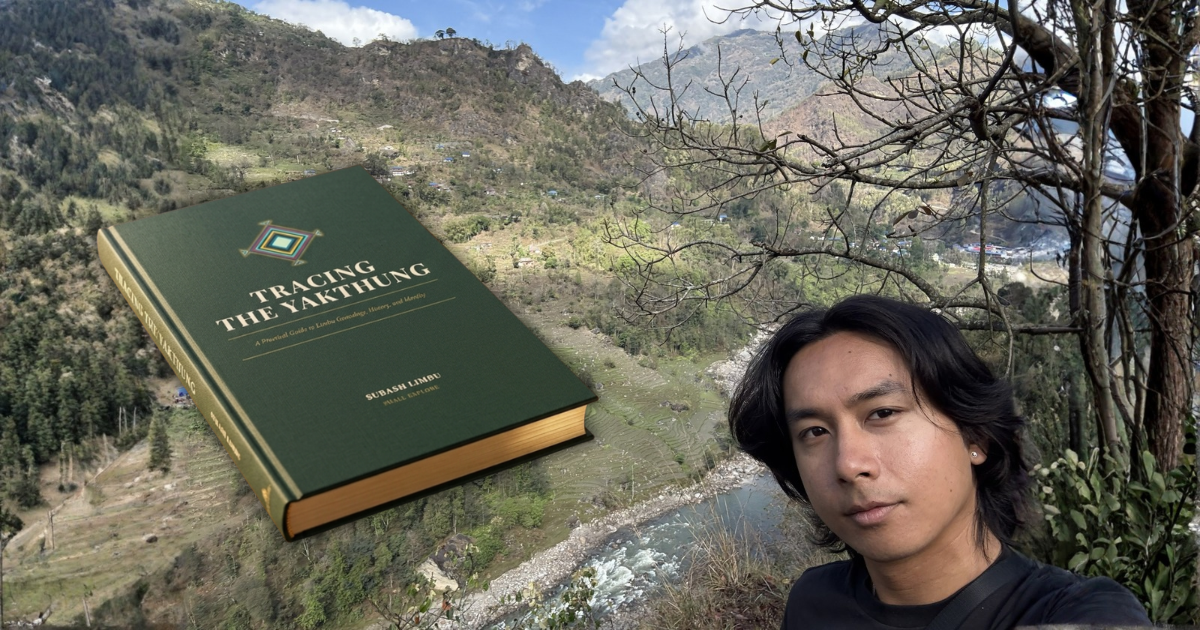
Why I Wrote Tracing the Yakthung
"Where Are You From?"
It started with a question I heard constantly while studying in Birmingham, UK: where are you from?
I started asking people to guess first. The most common answer was Japanese. Others were just as far off. I found it fascinating that my face could point strangers in so many directions, and I wanted to know if this was a one-off or a pattern.
The Social Experiment
I took the question to Hong Kong and spent a month asking people to guess my origin. The answers varied again, and the resulting video remains my most viewed to date.
Watch it here: [YouTube video link]
The response told me this question resonated far beyond me. Identity, appearance, and origin are things many people carry without a clear answer.
Testing the Question with DNA
I wanted evidence, so I took ancestry DNA tests with MyHeritage and Circle DNA. The results gave me data, but they also left me with more questions than answers about the people and places behind the numbers.
- MyHeritage: Watch my MyHeritage DNA results video: video link
- Circle DNA: Code: SUBASHCLIMBU 40%OFF | Watch my Circle DNA results video: video link
Three Years on the Ground in Limbuwan
DNA could only take me so far. I spent three years in Nepal, visiting towns, cities, and villages across Limbuwan, including more than 10 villages in Taplejung alone. I sat with elders, walked ancestral land, and obtained a genealogy book of my own Limbu clan.
I spent months in Limbuwan, where Limbu aka Yakthung people are mostly concentrated, and the names of the lands, mountains, rivers, villages, towns, spirits and all are in its own language. Wikipedia compares it to Old Chinese, Old Tibetan, Jingpho, Garo and the like. The Limbu language is in the Sino-Tibetan tree, with Mandarin being its most popular member, alongside Cantonese, Tibetan, Burmese and so on.
That fieldwork gave me raw, first-hand material that no database could provide.
Sharing What I Found
I turned the material into educational posts online. Along the way I collected more than 618 Limbu clans, one of the largest sets recorded and shared digitally.
People began commenting and asking for my opinion on history, names, and origins. The demand was clear: there was an audience for a clear, organised account of Yakthung heritage, and very little available in one place.
The Question That Led to the Book
One day I asked an AI a simple question: if you were me, what would you do? I believe I picked it up from Sabrina Ramonov, the AI entrepreneur, software educator, and social media creator.
The answer pointed to a book. Posts disappear in a feed. A book holds the research, the stories, and the clan records in one lasting place.
So I started writing.
What the Book Is
Tracing the Yakthung is the result of that journey: a personal question, a social experiment, DNA testing, and years of fieldwork, brought together as a record of Yakthung heritage for readers interested in indigenous tribes with hundreds of clans with ancient knowledge, systems, traditions, history, and wars. Genetically, linguistically, culturally and orally connected with east Asia, central Asia, southeast Asia, south Asia and Africa.
I wrote it for three reasons:
- To answer the question I was asked for years.
- To preserve clan knowledge that is at risk of being lost.
- To give the next generation a starting point I did not have.
About the Book
| Detail | Info |
|---|---|
| Title | Tracing the Yakthung |
| Author | Subash Limbu |
| Published | May 25, 2026 |
| Length | 40 pages |
Get a Copy
| Region / Format | Where to buy |
|---|---|
| United Kingdom | Amazon UK link |
| United States | Amazon US link |
| Canada | Amazon Canada link |
| Digital edition | Gumroad link |
| Nepal and India | Pothi link |
If this story resonates with you, I would be glad to hear where you are from and what you know of your own roots.
Disclosure: Some links in this post are affiliate links. I may earn a commission if you purchase through them, at no extra cost to you.
Connect with me
- YouTube: @ShallExplore
- Instagram: @subillion
- TikTok: @tsubashlimbu
- X: @subashlimbu
- Email: contactsubashlimbu@gmail.com